A single LISA glitch
Build equal-arm TDI-2 waveforms in time and frequency, then differentiate the Fourier response with JAX. Synthetic signals only; no external data or sampler.
Setup
Run this install cell in Colab or a fresh Python 3.12+ environment. For a local
checkout, use uv sync --locked --group examples instead. The docs build skips
this installation cell and uses its already installed package.
! pip install "jaxglitches @ git+https://github.com/jaxglitches/jaxglitches.git" matplotlib
%matplotlib inline
import jax
import jax.numpy as jnp
import jaxglitches as jg
import matplotlib.pyplot as plt
import numpy as np

plt.rcParams.update({"figure.figsize": (7, 3.5), "font.size": 11})
Build the responses
Use a 600 s window with 0.5 s sampling. Parameters are onset t0=120 s,
velocity kick Deltav=1.2e-13 m/s, and decay time tau=5 s.
Both responses use TDI-2 and AET channels.
t_obs, dt = 600.0, 0.5
t0, delta_v, tau = 120.0, 1.2e-13, 5.0
params = jnp.array([t0, delta_v, tau])
time = jnp.arange(0.0, t_obs, dt)
freq = jg.freq_grid(t_obs=t_obs, dt=dt)
h_time = jg.clean_signal_t(params, time, tdi=2, basis="AET")
h_freq = jg.clean_signal_f(params, freq, tdi=2, basis="AET")
print(f"Time response: {h_time.shape}; Fourier response: {h_freq.shape}")
Time response: (1200, 3); Fourier response: (601, 3)
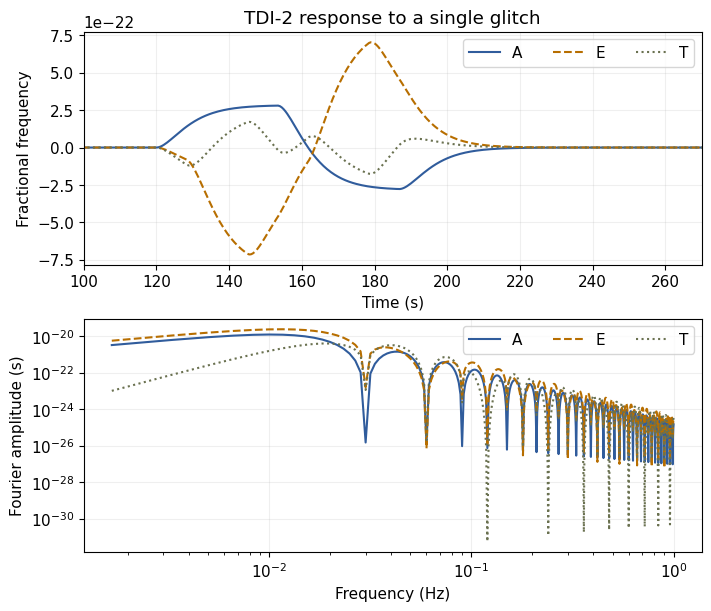
View the glitch
The time response is fractional frequency; the analytic Fourier transform has units of seconds. This is the noiseless response, not a noise PSD.
fig, axes = plt.subplots(2, 1, figsize=(7, 6), layout="constrained")
for column, (channel, color, style) in enumerate(
    zip("AET", ["#305c9c", "#b76e00", "#6a7150"], ["-", "--", ":"])
):
    axes[0].plot(time, h_time[:, column], label=channel, color=color, linestyle=style)
    axes[1].loglog(freq[1:], np.abs(h_freq[1:, column]),
                   label=channel, color=color, linestyle=style)
axes[0].set(xlim=(t0 - 20, t0 + 150), xlabel="Time (s)",
            ylabel="Fractional frequency", title="TDI-2 response to a single glitch")
axes[1].set(xlabel="Frequency (Hz)", ylabel="Fourier amplitude (s)")
for ax in axes:
    ax.legend(ncols=3)
    ax.grid(alpha=0.2)
plt.show()
Differentiate and check
The Jacobian has shape (frequency bins, channels, parameters), with parameter
order [t0, Deltav, tau]. These checks confirm shapes, finite values, and the
zero DC response. They do not test inference or recovery from noisy data.
jacobian = jax.jacfwd(
    lambda p: jg.clean_signal_f(p, freq, tdi=2, basis="AET")
)(params)
assert h_time.shape == (1200, 3)
assert h_freq.shape == (601, 3)
assert jacobian.shape == (601, 3, 3)
assert bool(jnp.all(jnp.isfinite(h_time)))
assert bool(jnp.all(jnp.isfinite(h_freq)))
assert bool(jnp.all(jnp.isfinite(jacobian)))
assert bool(jnp.all(h_freq[0] == 0))
print(f"Jacobian: {jacobian.shape}; all checks passed.")
Jacobian: (601, 3, 3); all checks passed.
Next steps
Change tau or the TDI generation and rerun. For likelihoods or unequal arms,
see the API reference and
conventions.